

Brand dynamics
Group Real-Time Dynamics And Cutting-Edge Information In The Field Of One Health

How to solve the problem of relapse into poverty due to illness? Health Yuan explores a long-term poverty alleviation approach in the health industry
Published Time:
2019-03-26
Years of hard work, only to be set back to square one by illness. The situation of families being impoverished by illness, and impoverished families being unable to afford medical care, has long been a major challenge to China's poverty alleviation efforts.
HealthGen, a company deeply involved in the pharmaceutical industry for over 20 years, has launched a unique combination of approaches in the field of precision poverty alleviation: providing medical care, medicine, and livelihoods, combining health poverty alleviation with industrial poverty alleviation to achieve the goal of permanently lifting more impoverished people out of poverty.

12 million people were impoverished or fell back into poverty due to illness.
In today's society, "chronic diseases" such as hypertension, diabetes, and bronchial asthma have become the leading causes of death among urban and rural residents in China. According to data, there are currently more than 300 million chronic disease patients in China, and deaths from "chronic diseases" account for 80% of deaths from illness in China, with the disease burden accounting for 70% of the total disease burden. To this end, the state has issued a series of policies to control the prevalence of chronic diseases in China. The prevention and control of "chronic diseases" in impoverished areas of China has also received great attention from the central government.
Statistics show that among the more than 30 million people still in poverty, about 40% were impoverished or fell back into poverty due to illness. Hu Jinglin, director of the National Healthcare Security Administration, said that most of the remaining people who have not escaped poverty are those with serious illnesses and poor conditions, and many of these illnesses are long-term, chronic, and easily recurrent. After the eradication of absolute poverty in 2020, there will still be a small number of people who are impoverished or fall back into poverty due to illness, and alleviating relative poverty will remain a long-term task.
As early as November 2015, the Central Poverty Alleviation and Development Conference held in Beijing listed the implementation of a health poverty alleviation program as one of the seven major actions to win the battle against poverty, requiring efforts to ensure that rural poor people enjoy basic medical and health services, prevent impoverishment and relapse into poverty due to illness, strengthen health poverty alleviation in impoverished areas, and continuously improve the precision and accuracy of poverty alleviation.
On November 23, 2016, the State Council issued the "13th Five-Year Plan for Poverty Alleviation," which, in accordance with the basic strategy of precision poverty alleviation and poverty eradication, adopted targeted measures tailored to local conditions and classified policies, detailing relevant paths and measures in eight aspects: 1. Poverty alleviation through industrial development; 2. Poverty alleviation through relocation for employment; 3. Poverty alleviation through relocation; 4. Poverty alleviation through education; 5. Poverty alleviation through health; 6. Poverty alleviation through ecological protection; 7. Bottom-line protection; 8. Social poverty alleviation.
Health poverty alleviation is undoubtedly the most arduous aspect of all poverty alleviation measures, and it is also the task with the heaviest burden, the most difficult implementation process, the longest duration, and the most professional division of labor and cooperation.
In October 2018, the National Healthcare Security Administration, together with the Ministry of Finance and the State Council's Poverty Alleviation Office, jointly issued the "Implementation Plan for the Three-Year Action on Health Poverty Alleviation (2018-2020)", requiring a focus on deeply impoverished areas such as the "Three Regions and Three Prefectures" and special impoverished populations such as those impoverished or falling back into poverty due to illness, giving full play to the role of basic medical insurance, major illness insurance, and medical assistance systems, and effectively improving the level of medical security enjoyed by rural impoverished populations.
HealthGen promotes long-term poverty alleviation.
HealthGen is undoubtedly one of the earliest pharmaceutical companies to engage in health poverty alleviation, but its poverty alleviation measures differ from those of other companies. HealthGen, through health poverty alleviation and industrial poverty alleviation, has enabled the impoverished in impoverished areas to achieve sustainable poverty alleviation.
First, while the whole country is fighting the battle against "chronic diseases" and "medical poverty alleviation," HealthGen and Lizhu Pharmaceutical Group are actively carrying out "medical poverty alleviation" measures, launching an offensive against "chronic diseases."
HealthGen has launched a special "Health Poverty Alleviation" plan, precisely targeting hypertension, hyperlipidemia, and cardiovascular and cerebrovascular diseases, donating millions of yuan worth of drugs, including Pravastatin Capsules, Amlodipine Besylate Capsules, Irbesartan Tablets, Valsartan Capsules, and Isosorbide Mononitrate Tablets, to impoverished counties in the Chaotian District of Guangyuan, Sichuan Province. These drugs can truly help economically disadvantaged families with illnesses, making it easier for patients in the region to obtain medicine nearby and providing timely assistance to low-income people.
The project manager said to the reporter that in the future, HealthGen will, according to the actual situation, regularly and continuously donate drugs to impoverished areas to help them escape poverty.
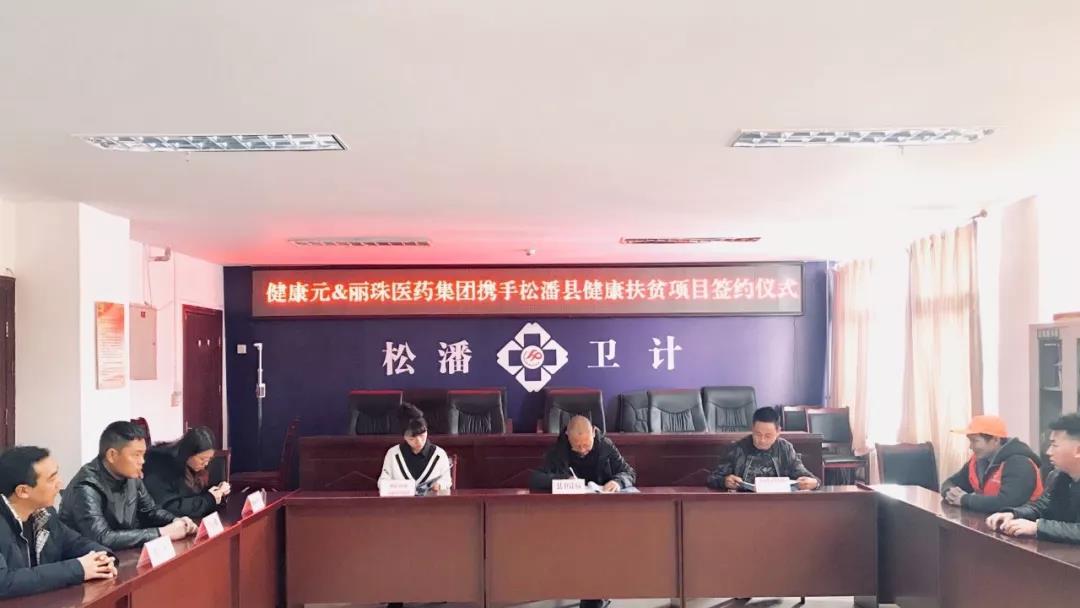
As early as November 16 last year, HealthGen also joined hands with the Songpan County Health and Family Planning Bureau of Aba Tibetan and Qiang Autonomous Prefecture, Sichuan Province, to hold a signing ceremony for a health poverty alleviation chronic disease project. According to the person in charge of HealthGen Group's health poverty alleviation project, the company will make poverty alleviation work a priority in the future, carrying out industrial poverty alleviation and chronic disease poverty alleviation projects simultaneously, so as to effectively help economically disadvantaged families with illnesses, making it easier for patients in minority areas to obtain medicine nearby and providing timely assistance to low-income people.
Giving a man a fish is not as good as teaching him to fish. While doing continuous work on health poverty alleviation, HealthGen has also gradually begun to promote industrial poverty alleviation, hoping to help more impoverished people escape poverty through a point-to-area approach.
To this end, HealthGen mentioned in its 2018 semi-annual report that it would explore a new path to enrich the people based on local resources and the development of the characteristic Astragalus industry from the perspective of industrial poverty alleviation, achieving poverty alleviation in situ and promoting the construction of an "ecological Chinese medicine base."
The specific approach is to establish the concept of 'precision poverty alleviation and Astragalus industry,' do a good job of 'three combinations' (combining with poverty alleviation policies, industrial development projects, and vocational skills training), adopting the poverty alleviation model of 'company-base-impoverished household,' and radiating and driving impoverished households to plant and process Astragalus, creating a local Astragalus medicinal material industry in a way that suits local conditions, forming a long-term and pillar industry for poverty alleviation and wealth creation.
As early as the first half of 2018, Datong Lizhu Qiyuan Medicinal Materials Co., Ltd. (Datong Lizhu), a subsidiary of Lizhu Group, a subsidiary of HealthGen, employed hundreds of local farmers in its self-built and jointly built bases, and trained the farmers on how to use non-toxic and harmless methods to solve pest problems in Astragalus cultivation, avoiding losses of 2,000 mu of Astragalus due to pests.
In addition, HealthGen plans to achieve comprehensive and stable poverty alleviation for hundreds of people in the three counties of Hunyuan and Tianzhen in Shanxi and Zizhou in Shaanxi through industrial poverty alleviation. In the future, HealthGen will gradually complete the training of standardized Astragalus planting and processing technologies, create standardized production demonstration bases, include impoverished households in the scope of base construction, and improve the conditions for Astragalus production among the people in impoverished areas.
The specific approach is to sign Astragalus purchase orders with impoverished households. Under the premise of standardized production, after the produced Astragalus meets the enterprise standards, the enterprise will give priority to purchasing the products of impoverished households at a protective price. The so-called protective price refers to the comprehensive consideration of land transfer costs, labor costs, and organic fertilizer costs paid by pharmaceutical companies to farmers, especially labor costs, which need to take into account the local cost of living.
The greatest contribution of HealthGen's industrial poverty alleviation model is that it has created a point-to-area demonstration effect locally. HealthGen's series of measures have not only provided sufficient guarantees for the stability of medicinal material prices for local farmers, but also the more advanced planting technologies brought by large pharmaceutical companies have enabled farmers to abandon primitive planting technologies. In addition, the organic certification standards for Chinese medicinal materials implemented by large pharmaceutical companies will also enable farmers to abandon the use of pesticides and chemical fertilizers, thus ensuring that medicinal materials are pollution-free and residue-free.
Quick Navigation
+86 755-33268688 | Service Hotline

Official WeChat Official Account
Copyright © 2025 Joincare Pharmaceutical Group Industry Co., Ltd. ALL Rights Reserve.