

Brand dynamics
Group Real-Time Dynamics And Cutting-Edge Information In The Field Of One Health

Behind the "surprise attack" of Jiankangyuan on the tens of billions of flu market
Published Time:
2024-12-18
Mapasivavet arrived just in time for the season.
In early December, the National Pharmacopoeia Committee approved the application for the generic name "Mapasivavet" for the influenza innovative drug developed by Health Spring (600380.SH). This means that the blockbuster new drug, which Health Spring regards as a "milestone," is on the verge of official launch.
In the current booming innovative drug market, where domestic pharmaceutical companies are pinning their hopes on innovation-driven growth, the key to widening the gap between pharmaceutical companies lies in the speed of innovative drug product launch and pipeline reserves.
It must be said that Health Spring, as a large comprehensive pharmaceutical company in China, has been under considerable growth pressure in the past two or three years.
On the one hand, it has experienced a gradual shift in its strategic focus from raw materials and generic drugs to innovative drugs, and the high proportion of R&D investment for many years needs to be realized in the consumer market and capital market;
On the other hand, in the environment of drug price control and medical insurance cost control, pharmaceutical companies themselves are facing downward pressure on profitability, and Health Spring also needs to achieve domestic BigPharma is constantly rebalancing its strategy and making various preparations for the future.
Therefore, only by accelerating the listing process of innovative drugs and improving the efficiency of commercial operations can the growth pressure of listed companies be alleviated. But everyone knows that in the field of innovative drugs with "10 billion yuan in 10 years," this is very difficult.

By introducing high-quality innovative drugs, Health Spring is accelerating its innovative transformation.
But now, in addition to the previously launched Tobramycin Inhalation Solution (Jianketo ®) and the imminent launch of Mapasivavet, Health Spring still has 7 innovative drugs that have entered clinical Phase II, which should make the outside world feel that Health Spring has entered the value release period of innovative drugs. In addition,
we have also observed another change taking place in Health Spring: "Taking the implementation of the innovation development strategy as the core of the company's development." Around this strategic core, Health Spring is more open to accelerating its innovative transformation by introducing high-quality innovative drugs. On the capital market side, as the policy effects of centralized procurement, etc., begin to decrease marginally, coupled with the continuous listing and commercialization of innovative drugs, pharmaceutical companies such as Health Spring, which have initially completed
"the switch from imitation to innovation," will be the first to return to high growth. It's still the same sentence:
"Persisting in doing what is difficult but correct" can ultimately make the results more valuable. 1
|Hundreds of billions of exclusive market A game-changer emerges
Almost every winter flu season, we hear news of Oseltamivir shortages in various places.
As the patent holder of Oseltamivir, Roche Pharmaceuticals has undoubtedly dominated the Chinese anti-influenza drug market. Since
2002, when the original Oseltamivir drug (Tamiflu ®) was approved for listing in China, to 2023, the total sales across various channels reached 9.863 billion RMB (data source: PDB data). Roche Pharmaceuticals has made a fortune from Tamiflu ® and Oseltamivir patent licensing. According to data from the National Center for Disease Control and Prevention,
2023 saw a surge of 10.2854 million cases of influenza in China compared to 2022, reaching 12.5282 million cases, with an incidence rate of 888 per 100,000; in the first half of this year, the number of influenza cases in China reached 6.22 million, indicating that this winter may again be a "big year" for influenza outbreaks. Correspondingly,
in 2023, the domestic anti-influenza drug market surged to a scale of over 10 billion yuan, reaching 11.4 billion yuan (data source: PDB data), with Oseltamivir accounting for 86.48% of the market share. Due to the significant price drop of Oseltamivir after national negotiations and centralized procurement, coupled with the rapid increase in production capacity and sales of domestic Oseltamivir generic drugs in recent years,
in 2023, Roche's Tamiflu ® accounted for 14.05% of Oseltamivir sales, ranking second but far behind Yangtze River Pharmaceutical's 65%. In order to maintain its
"dominant" position in the anti-influenza drug field, in April 2021, Roche introduced the original new-generation drug for treating influenza A and B, Mabaloxavet (Xofluza ®), into the Chinese market.
Indeed, the subsequent market performance of Mabaloxavet has shown great potential to inherit the mantle of Oseltamivir as an "anti-influenza miracle drug."
In 2023, domestic sales of Mabaloxavet tablets exceeded 500 million yuan, with a year-on-year increase of 750%. Mabaloxavet, which is more effective than Oseltamivir, is now included in the medical insurance catalog, and it is highly likely that it will continue to increase in volume and gradually "replace" Oseltamivir.
But will Roche recreate the miracle of Oseltamivir? The domestic market will obviously not simply follow suit.
Mabaloxavet has only been on the market in China for over half a year, and Shijiazhuang Pharmaceutical Group's first generic drug has already been launched on Roche's heels, but this is not the real threat to Roche in the field of new-generation anti-influenza drugs.
According to information retrieved from "Peptide Chain," Health Spring's Mapasivavet and Roche's Mabaloxavet are both PA target nuclease inhibitors, but their molecular structures are different, meaning that Mapasivavet is also an original drug. 。
From the Phase III clinical trials comparing Mapasivavet and Mabaloxavet to placebo, in terms of symptom relief time for influenza B and adolescent patients, Mapasivavet is faster and more effective than Mabaloxavet, and its overall drug resistance rate is also lower.
In terms of the time window for market launch, this year In April, HealthGen completed Phase III clinical trials of mapakisav, submitted a domestic registration application in August, and obtained the generic name in December. It is expected to be officially launched as early as mid-2025.
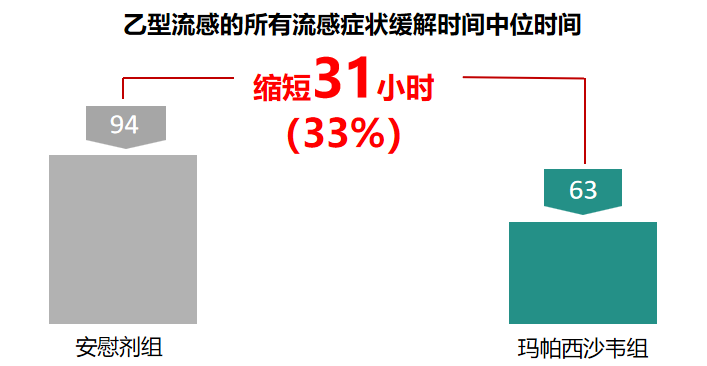
In Phase III clinical trials, the median time to alleviation of all influenza symptoms in patients with influenza B was shortened by 31 hours with mapakisav compared to placebo.
In other words, Roche has just warmed up the market for mabaloxav, and domestic pharmaceutical companies are rushing to launch innovative drugs that are PA-targeted nuclease inhibitors.
In the innovative research and development of new-generation antiviral drugs, Roche is clearly no longer in the leading position it held during the "oseltamivir" era.
Next, it remains to be seen how HealthGen will leverage its mature commercialization operation system to translate the outstanding clinical trial results of mapakisav into market value, given the increasing market attention towards domestically produced innovative drugs.
II |Accelerated Innovation
Self-developed and imported, both strong
From tobramycin inhalation solution to mapakisav preparation, HealthGen's core strategy for innovative development is accelerating its implementation.
In November 2022, HealthGen's independently developed tobramycin inhalation solution (Jianketo®) for adults with bronchiectasis and other indications accompanied by Pseudomonas aeruginosa infection in the lungs was approved for marketing; in 2023, Jianketo was officially included in the National Medical Insurance Drug Catalog, with an agreement period from January 1, 2024 to December 31, 2025.
Jianketo, which fills the gap in the domestic inhaled antibiotic market, not only elevates HealthGen's leading position in the domestic respiratory preparation field, but also represents a major new drug marking the implementation of its innovative development strategy.

Previously, HealthGen had already established its approach to launching innovative drugs: focusing on new targets and mechanisms, targeting various indications and dosage forms in the respiratory field, and implementing a full-scenario layout in inhalation preparations, oral medications, and injections.
With a clear strategy, action is swift.
In the first quarter of this year, HealthGen successively launched innovative monoclonal antibody drugs targeting TSLP for the treatment of moderate to severe asthma/COPD, long-acting monoclonal antibodies targeting IL-4R for the treatment of moderate to severe asthma/COPD, and oral innovative drugs targeting PREP for the treatment of COPD.
TSLP is a globally highly-focused target for the treatment of COPD. Overseas research data shows that products targeting TSLP can effectively reduce the frequency of acute exacerbations in patients with moderate to severe COPD. Meanwhile, in terms of oral medications for COPD, globally only roflumilast has been approved for oral treatment of COPD, but it has significant side effects and has not entered China. If successfully developed, this will become China's first oral medication for the treatment of COPD.
These are just the achievements in the field of respiratory medications. In addition to the anti-influenza Class 1 new drug mapakisav, HealthGen has also "crossed over" into areas such as analgesic drugs, introducing innovative non-opioid small molecule drugs with great market potential.
HealthGen's first analgesic innovative drug, as a highly selective second-generation Nav1.8 inhibitor, has the advantages of safe efficacy and non-addictive analgesia, and is expected to become China's first non-addictive non-opioid analgesic.
Currently, HealthGen holds over 20 innovative drugs. These innovative drug projects with great potential are currently being actively advanced in clinical trials, and their progress is currently among the top in China.
Everything is to accelerate innovation.
At the Q3 earnings conference call this year, HealthGen's management reiterated that innovative drugs are the group's most important strategic goal, and the company will continue to increase its R&D efforts in innovative drugs and continue to strengthen its pipeline layout in areas such as respiratory, digestive, assisted reproduction, and psychiatric drugs.
Judging from HealthGen's innovative drug pipeline layout and advancement pace, the company has indeed established the basic form and continuous growth momentum of a leading domestic Big Pharma.
However, in the market environment of accelerated global innovative drug R&D, fierce competition in innovative drugs, and frequent mergers and acquisitions, HealthGen's management is clearly aware of the harsh realities.
Therefore, accelerating innovative development in an unconventional manner will be HealthGen's unwavering primary task for a long time to come.
III |Revaluation
Attractiveness of Innovation-Driven Development
An investor on a certain platform raised a question: Why does HealthGen, an innovative drug company with so many pipeline products, remain at a consistently low PE and PB ratio?
In fact, this is a common problem that puzzles investors in the pharmaceutical industry. Applying this question to most A-share pharmaceutical companies is also applicable. After several years of continuous adjustment, the overall market capitalization of listed pharmaceutical companies remains at a relatively low level.
Although many securities research institutions believe that driven by the dual resonance of policy cycles and technological cycles, China's pharmaceutical industry is entering its best era and is therefore expected to experience a revaluation, market funds do not seem to favor listed pharmaceutical companies so much.
From the questions raised by ordinary investors and the statements of professional analysis institutions, one point is worth noting, that is, taking China's pharmaceutical industry entering the innovation harvest period as the anchor point, investors and analysts believe that innovative drug companies should be revalued.
So how should the asset value of China's innovative pharmaceutical companies be evaluated? Let's look at some M&A cases.
On November 13, Promis Biotechnology Co., Ltd., a Chinese innovative biopharmaceutical R&D company registered in 2018, announced that it had reached a share acquisition agreement with BioNTech of Germany, with the latter acquiring Promis for approximately RMB 5.8 billion.
Similar Chinese innovative pharmaceutical companies are being At least five M&A deals involving multinational pharmaceutical companies have occurred in the past year, each valued at tens of billions of RMB.
Without discussing the valuation of these M&A deals, the fact that multinational pharmaceutical consortia are “sweeping up” innovative pharmaceutical assets in China itself demonstrates that the value of these assets is recognized by international industrial capital.
In fact, this recognition of value has also appeared in the A-share market's pharmaceutical companies. In the list of major shareholders of HealthGen's circulating shares in its third-quarter report, the Abu Dhabi Investment Authority, holding 12,500,240 shares, ranks eighth. Since the end of 2022, the Abu Dhabi Investment Authority has been continuously increasing its holdings of HealthGen's circulating shares.

The Abu Dhabi Investment Authority's continued increase in its holdings of HealthGen reflects its recognition of HealthGen's innovative development strategy and corporate value.
Source: Securities Market Weekly Data Source: Wind Data
The Abu Dhabi Investment Authority is the UAE's sovereign wealth fund. By the end of the third quarter of this year, it appeared in the top ten shareholder lists of 24 A-share listed companies. HealthGen is one of only two A-share pharmaceutical listed companies invested in by the Abu Dhabi Investment Authority; the other is Lizhu Group, a company controlled by HealthGen.
Perhaps the basic logic behind the Abu Dhabi Investment Authority's continued increase in its holdings of HealthGen in recent years is its recognition of the company's innovative development strategic goals and corporate value.
However, from the perspective of active market value management, there is not much that listed companies themselves can do.
As HealthGen's official response to investors states, it actively strengthens communication and exchanges with investors, and continuously rewards investors through share buybacks and cash dividends.
In the nearly five years from 2020 to 2024, HealthGen's cumulative cash dividends (including the amount of share buybacks) totaled nearly 4 billion yuan. For three consecutive years, HealthGen's annual cash dividend ratio to net profit attributable to the parent company has been as high as about 60%. This level of dividend distribution is a fairly good return rate in the A-share market.
In other words, HealthGen's willingness to distribute a high proportion of its profits as cash dividends demonstrates its confidence in the future revaluation of the listed company. After all, with its years of efforts to promote the transformation and development of innovative drugs, HealthGen has now entered the “harvest period”.
This article is from: Polypeptide Chain
Quick Navigation
+86 755-33268688 | Service Hotline

Official WeChat Official Account
Copyright © 2025 Joincare Pharmaceutical Group Industry Co., Ltd. ALL Rights Reserve.