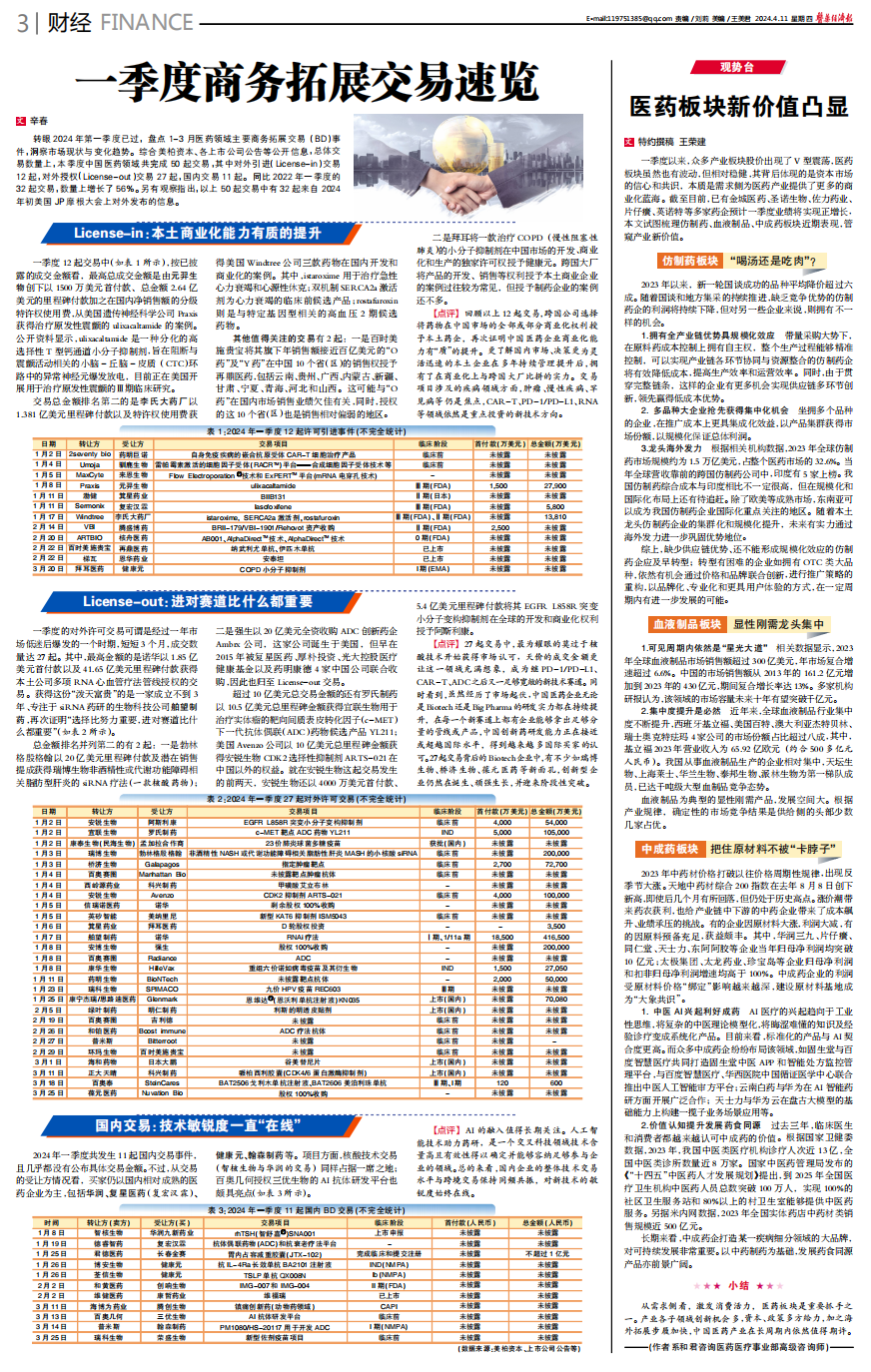
The first quarter of 2024 has passed. This is a review of the major business development (BD) transactions in the pharmaceutical field from January to March, providing insights into the current market situation and trends. Based on publicly available information from sources such as Meibai Capital and various listed company announcements, a total of 50 transactions were completed in the Chinese pharmaceutical sector this quarter. These include 12 inbound licensing (License-in) transactions, 27 outbound licensing (License-out) transactions, and 11 domestic transactions. Compared to 32 transactions in the first quarter of 2022, this represents a 56% increase. It has also been observed that 32 of these 50 transactions originated from information released at the J.P. Morgan Healthcare Conference in early 2024 in the United States.
License-in: A qualitative improvement in domestic commercialization capabilities
Among the 12 transactions in the first quarter (as shown in Table 1), based on the disclosed transaction amounts, the highest total transaction amount was Yuanyi Bio which achieved a deal with a $15 million upfront payment and a total of $264 million in milestone payments plus tiered royalties on net sales in China from Praxis, a US genetic neuroscience company, for ulixacaltamide, a treatment for essential tremor. Public information shows that ulixacaltamide is a highly selective, differentiated small molecule T-type calcium channel inhibitor designed to block abnormal neuronal burst firing in the cerebello-thalamo-cortical (CTC) loop associated with tremor activity. It is currently undergoing Phase III clinical trials in the US for the treatment of essential tremor.
 The second highest total transaction amount was Lee's Pharmaceutical which acquired the rights to develop and commercialize three drugs from Windtree in China for $138.1 million in milestone payments and royalties. These include istaroxime for the treatment of acute heart failure and cardiogenic shock; a dual-mechanism SERCA2a activator, a preclinical candidate for heart failure; and rostafuroxin, a Phase II candidate drug for hypertension associated with specific genotypes.
Other noteworthy transactions include two transactions: Firstly, Bristol Myers Squibb granted the sales rights of its "O drug" and "Y drug" (with annual sales of nearly $10 billion) in 10 provinces (regions) of China to Innovent Biologics, including Yunnan, Guizhou, Guangxi, Inner Mongolia, Xinjiang, Gansu, Ningxia, Qinghai, Hebei, and Shanxi. This may be related to the poor sales performance of the "O drug" in the domestic market, and the 10 provinces (regions) where the rights were granted also have relatively weak sales.
Secondly, Bayer granted the exclusive license for the development, commercialization, and production of a small molecule inhibitor for COPD (chronic obstructive pulmonary disease) in the Chinese market to HealthGen. While it is common for multinational pharmaceutical companies to grant development and sales rights to domestic commercial enterprises, cases of granting such rights to pharmaceutical companies are less frequent.
【Comments】 Reviewing the above 12 transactions, the choice of multinational companies to grant all or part of the commercialization rights in the Chinese market to domestic pharmaceutical companies once again demonstrates a qualitative improvement in the commercialization capabilities of Chinese pharmaceutical companies. Domestic companies, with their deeper understanding of the domestic market and more flexible and rapid decision-making, have, after years of continuous management improvement, gained the strength to compete with multinational giants in commercialization. In terms of the disease areas involved in the transactions, tumors, chronic diseases, and rare diseases remain the focus, while CAR-T, PD-1/PD-L1, and RNA remain key investment areas for new technologies.
The second highest total transaction amount was Lee's Pharmaceutical which acquired the rights to develop and commercialize three drugs from Windtree in China for $138.1 million in milestone payments and royalties. These include istaroxime for the treatment of acute heart failure and cardiogenic shock; a dual-mechanism SERCA2a activator, a preclinical candidate for heart failure; and rostafuroxin, a Phase II candidate drug for hypertension associated with specific genotypes.
Other noteworthy transactions include two transactions: Firstly, Bristol Myers Squibb granted the sales rights of its "O drug" and "Y drug" (with annual sales of nearly $10 billion) in 10 provinces (regions) of China to Innovent Biologics, including Yunnan, Guizhou, Guangxi, Inner Mongolia, Xinjiang, Gansu, Ningxia, Qinghai, Hebei, and Shanxi. This may be related to the poor sales performance of the "O drug" in the domestic market, and the 10 provinces (regions) where the rights were granted also have relatively weak sales.
Secondly, Bayer granted the exclusive license for the development, commercialization, and production of a small molecule inhibitor for COPD (chronic obstructive pulmonary disease) in the Chinese market to HealthGen. While it is common for multinational pharmaceutical companies to grant development and sales rights to domestic commercial enterprises, cases of granting such rights to pharmaceutical companies are less frequent.
【Comments】 Reviewing the above 12 transactions, the choice of multinational companies to grant all or part of the commercialization rights in the Chinese market to domestic pharmaceutical companies once again demonstrates a qualitative improvement in the commercialization capabilities of Chinese pharmaceutical companies. Domestic companies, with their deeper understanding of the domestic market and more flexible and rapid decision-making, have, after years of continuous management improvement, gained the strength to compete with multinational giants in commercialization. In terms of the disease areas involved in the transactions, tumors, chronic diseases, and rare diseases remain the focus, while CAR-T, PD-1/PD-L1, and RNA remain key investment areas for new technologies.
License-out: Choosing the right track is more important than anything else
Outbound licensing transactions in the first quarter marked a period of explosive growth after a year of market downturn. In just three months, 27 transactions were completed. The highest amount was Novartis's acquisition of multiple RNA cardiovascular therapy pipelines from a domestic company for an upfront payment of $185 million and milestone payments of $4.165 billion. The recipient of this "windfall" is a biotechnology company focusing on siRNA drug research that was founded less than three years ago, Bowang Pharmaceutical This once again proves that "choice is more important than effort, and choosing the right track is more important than anything else" (as shown in Table 2).
 Two transactions tied for second place in terms of total amount: Firstly, Boehringer Ingelheim acquired a siRNA therapy (a nucleic acid drug) for non-alcoholic or metabolic dysfunction-associated fatty liver disease from Ribobio for $2 billion in milestone payments and potential sales royalties; Secondly, Johnson & Johnson acquired Ambrx, an ADC innovative drug company, for $2 billion. This company was founded in the United States, but was acquired in 2015 by four Chinese companies: Fosun Pharma, Hupan Capital, China Guangda International Leasing's healthcare fund, and WuXi AppTec, therefore it is also classified as a License-out transaction.
Other transactions exceeding $1 billion in total value include Roche's acquisition of YL211, a next-generation antibody-drug conjugate (ADC) targeting c-MET for the treatment of solid tumors, from Yiliang Bio for a total milestone amount of $1.05 billion; and Avenzo's acquisition of the rights to ARTS-021, a CDK2 selective inhibitor, outside of China from Anrui Bio for a total milestone amount of $1 billion. Just two days before this transaction with Anrui Bio, Anrui Bio granted AstraZeneca the global development and commercialization rights to its EGFR L858R mutation small molecule allosteric inhibitor for an upfront payment of $40 million and milestone payments of $540 million.
【Comments】 Among the 27 transactions, the most striking aspect is the market's growing recognition of nucleic acid technology. The huge transaction amounts have fueled imagination in this field, making it the next major technological track after PD-1/PD-L1, CAR-T, and ADC. It is also observed that despite market fluctuations, the R&D capabilities of Chinese pharmaceutical companies, both Biotech and Big Pharma, are continuously improving. Companies in every new track are able to produce pipelines or products of sufficient weight, and China's innovative drug R&D capabilities are approaching or exceeding international levels, gaining recognition from more and more international buyers. Among the Biotech companies behind the 27 transactions, there are many new faces such as Ribobio, Qiaoji Bio, and Baoyuan Pharmaceutical, demonstrating that innovative companies are still emerging, growing strongly, and achieving breakthroughs.
Two transactions tied for second place in terms of total amount: Firstly, Boehringer Ingelheim acquired a siRNA therapy (a nucleic acid drug) for non-alcoholic or metabolic dysfunction-associated fatty liver disease from Ribobio for $2 billion in milestone payments and potential sales royalties; Secondly, Johnson & Johnson acquired Ambrx, an ADC innovative drug company, for $2 billion. This company was founded in the United States, but was acquired in 2015 by four Chinese companies: Fosun Pharma, Hupan Capital, China Guangda International Leasing's healthcare fund, and WuXi AppTec, therefore it is also classified as a License-out transaction.
Other transactions exceeding $1 billion in total value include Roche's acquisition of YL211, a next-generation antibody-drug conjugate (ADC) targeting c-MET for the treatment of solid tumors, from Yiliang Bio for a total milestone amount of $1.05 billion; and Avenzo's acquisition of the rights to ARTS-021, a CDK2 selective inhibitor, outside of China from Anrui Bio for a total milestone amount of $1 billion. Just two days before this transaction with Anrui Bio, Anrui Bio granted AstraZeneca the global development and commercialization rights to its EGFR L858R mutation small molecule allosteric inhibitor for an upfront payment of $40 million and milestone payments of $540 million.
【Comments】 Among the 27 transactions, the most striking aspect is the market's growing recognition of nucleic acid technology. The huge transaction amounts have fueled imagination in this field, making it the next major technological track after PD-1/PD-L1, CAR-T, and ADC. It is also observed that despite market fluctuations, the R&D capabilities of Chinese pharmaceutical companies, both Biotech and Big Pharma, are continuously improving. Companies in every new track are able to produce pipelines or products of sufficient weight, and China's innovative drug R&D capabilities are approaching or exceeding international levels, gaining recognition from more and more international buyers. Among the Biotech companies behind the 27 transactions, there are many new faces such as Ribobio, Qiaoji Bio, and Baoyuan Pharmaceutical, demonstrating that innovative companies are still emerging, growing strongly, and achieving breakthroughs.
Domestic Transactions: Consistent technological acumen
A total of 11 domestic transactions occurred in the first quarter of 2024, and almost none of them disclosed the specific transaction amounts. However, judging from the acquirers, the buyers are still mainly relatively mature domestic pharmaceutical companies, including China Resources, Fosun Pharma (Fuhong Hanlin), HealthGen, and Hansoh Pharma etc. In terms of projects, nucleic acid technology transactions (the transaction between Zhihe Bio and China Resources) also occupy a place; and the authorization of Baio Geometry's AI antibody development platform to Sanyu Bio is also quite noteworthy (as shown in Table 3).
 【Comments】 The integration of AI is worth long-term attention. Artificial intelligence technology assists pharmaceutical research, a cross-disciplinary technological field with high technological content and proven effectiveness, capable of accommodating a sufficient number of participating companies. Overall, the overall technological transaction level of domestic enterprises maintains resonance with cross-border transactions, and their sensitivity to new technologies remains consistently high.
First published in the 4583rd issue of "Pharmaceutical Economics News"
This article is transferred from: Pharmaceutical Economics News
【Comments】 The integration of AI is worth long-term attention. Artificial intelligence technology assists pharmaceutical research, a cross-disciplinary technological field with high technological content and proven effectiveness, capable of accommodating a sufficient number of participating companies. Overall, the overall technological transaction level of domestic enterprises maintains resonance with cross-border transactions, and their sensitivity to new technologies remains consistently high.
First published in the 4583rd issue of "Pharmaceutical Economics News"
This article is transferred from: Pharmaceutical Economics News